1. Introduction
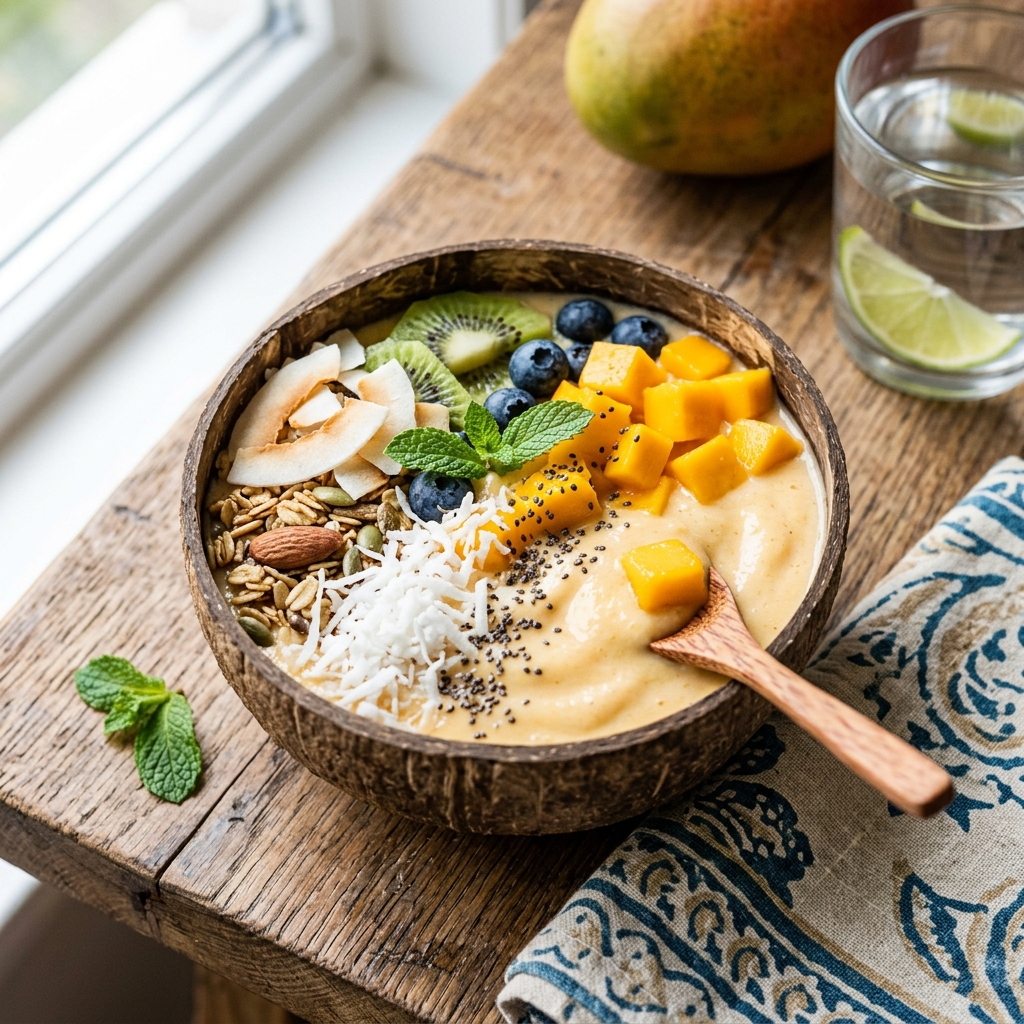
Imagine waking up not to the sound of an alarm clock, but to the gentle rustle of palm fronds and the salty mist of the Pacific Ocean. While we can’t all live on a tropical island, we can certainly eat like we do. TheMango Coconut Bowlis more than just a trend; it is a celebration of nature’s most vibrant flavors.
This dish finds its roots in the coastal regions of Southeast Asia and the Pacific Islands, where mangoes are often referred to as the “king of fruits.” Traditionally, mango and coconut were paired in warm sticky rice dishes. However, as modern culinary preferences shifted toward lighter, nutrient-dense meals, the “Smoothie Bowl” evolution took over.
What makes this specific recipe significant is the balance of textures. You have the velvet-smooth base of frozen mango and rich coconut cream, contrasted with the crunch of toasted flakes and the burst of fresh berries. It’s a sensory experience that transitions perfectly from a post-workout refuel to a sophisticated brunch centerpiece.
2. Recipe Overview
- Cuisine Type:Tropical / Fusion
- Difficulty Level:Easy
- Prep Time:10 minutes
- Total Time:10 minutes
- Dietary Classifications:Vegan, Vegetarian, Gluten-Free, Dairy-Free, Paleo-friendly
3. Equipment and Tools
To achieve that signature “soft-serve” consistency, the quality and type of tools you use are paramount.
- High-Speed Blender:A blender with at least 1200 watts of power is recommended to crush frozen fruit without needing excess liquid.
- Food Processor (Optional):If you don’t have a high-speed blender, a food processor is actually better for thick bowls as the wide blades incorporate less air.
- Silicone Spatula:Essential for scraping down the sides of the blender.
- Chilled Serving Bowls:Using a bowl that has been in the freezer for 10 minutes prevents the mixture from melting too quickly.
- Measuring Cups/Spoons:For precision in balancing the coconut-to-mango ratio.
4. Serving Suggestions
The beauty of a Mango Coconut Bowl lies in the “theatrics” of the toppings.
- Plating:Arrange your toppings in linear rows or a crescent shape to create a professional, “Instagrammable” look.
- Garnish Ideas:Edible pansies, mint sprigs, or a dusting of bright green matcha powder.
- Complementary Sides:A side of protein-rich avocado toast on sourdough or a handful of macadamia nuts.
- Beverage Pairings:A cold-brew hibiscus tea or a sparkling lime water complements the sweetness of the mango perfectly.
5. Nutritional Information
(Estimated per serving)
| Nutrient | Amount |
| Calories | 340 kcal |
| Total Fat | 12g |
| Saturated Fat | 9g |
| Carbohydrates | 56g |
| Fiber | 8g |
| Sugars | 42g |
| Protein | 4g |
Health Benefits:
- Vitamin C:One bowl provides over 100% of your daily requirement, boosting immune function.
- Healthy Fats:Medium-chain triglycerides (MCTs) from coconut milk provide a quick energy source.
- Digestion:High fiber content supports a healthy gut microbiome.
6. Storage and Reheating
- Storage:This dish is best enjoyed immediately. However, if you have leftovers, store them in an airtight container.
- Refrigeration:Not recommended for more than 2 hours, as the texture will turn into a liquid smoothie.
- Freezing:You can freeze the mixture in silicone ice cube trays. When ready to eat, simply re-blend the “cubes” with a splash of coconut milk.
- Reheating:N/A (This is a cold dish).
7. Expert Tips and Variations
Professional Chef Tips
- The Frozen Factor:Always use frozen mango chunks for the base. Fresh mango will result in a soup-like consistency rather than a thick bowl.
- Liquid Control:Add your coconut milk one tablespoon at a time. The goal is to use theminimumamount of liquid necessary to get the blades moving.
Creative Variations
- The “Protein Punch”:Add a scoop of vanilla pea protein or collagen peptides.
- The “Green Glow”:Toss in a handful of baby spinach; the mango is sweet enough to mask the taste completely.
- Seasonal Adaptation:In winter, add a pinch of ground ginger and turmeric to the blend for a warming, anti-inflammatory kick.
8. Ingredients Section
The Base
- Frozen Mango:2 cups (approx. 300g). Ensure they are “cheek” cuts or 1-inch cubes.
- Coconut Milk:1/4 cup to 1/2 cup (60ml – 120ml) full-fat canned coconut milk for maximum creaminess.
- Frozen Banana:1/2 banana (optional, for added creaminess).
- Lime Juice:1 tsp (freshly squeezed) to cut through the richness.
The Toppings
- Toasted Coconut Flakes:2 tbsp.
- Fresh Fruit:Sliced kiwi, raspberries, or blueberries.
- Granola:1/4 cup of grain-free or honey-almond granola.
- Chia Seeds:1 tsp for a boost of Omega-3s.
9. Step-by-Step Instructions
- Prep the Blender:Place your blender jar in the freezer for 5 minutes. Cold equipment helps maintain the frozen texture.
- Layer the Ingredients:Add the frozen mango (and banana, if using) to the blender first, followed by the lime juice.
- The Initial Pulse:Pulse the blender 5–10 times to break the large frozen chunks into smaller pieces.
- Incorporate the Liquid:Pour in 1/4 cup of the coconut milk.
- The High-Speed Blend:Blend on high. Stop every 20 seconds to use a spatula to push the unblended fruit down toward the blades.
- Assess Consistency:If the blender is “spinning air,” add one more tablespoon of coconut milk. You are looking for a thick, “vortex” ripple in the mixture.
- Transfer:Scoop the mixture into your chilled bowl. Use the back of a spoon to create a smooth surface or a swirl.
- Decorate:Top with your granola, seeds, and fresh fruit immediately.
- Serve:Consume within 10 minutes for the best experience.
10. Frequently Asked Questions (FAQ)
Q: Can I use light coconut milk instead of full-fat?
A: You can, but the bowl will be less creamy and may melt faster. Full-fat canned coconut milk provides the lipids necessary for a luxurious mouthfeel.
Q: My blender isn’t moving! What do I do?
A: Do not just add more liquid. Instead, stop the blender, stir the ingredients manually to remove air pockets, and try again. Use a “tamper” tool if your blender has one.
Q: Is this bowl too high in sugar?
A: While mangoes contain natural sugars (fructose), they also contain fiber which slows down sugar absorption. To lower the glycemic load, increase the amount of seeds (chia/hemp) and nuts used as toppings.
Q: Can I make this ahead of time for meal prep?
A: It is best to prep theingredients(pre-measure the frozen fruit), but the blending should happen right before eating.
Q: What is the best type of mango to use?
A: For freezing,AlphonsoorHoney (Ataulfo)mangoes are best because they are less fibrous and much sweeter than the standard Tommy Atkins variety found in most grocery stores.