1. Introduction
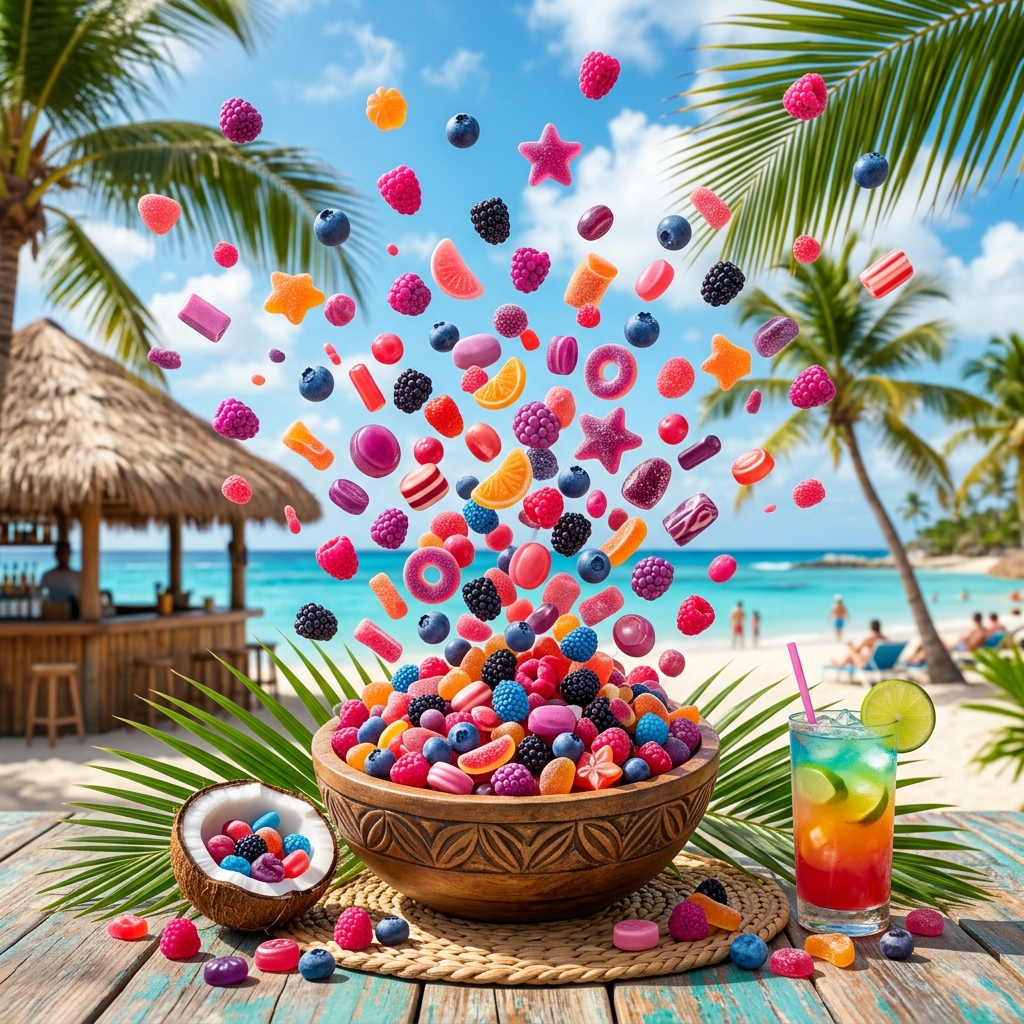
Imagine standing on a sun-drenched beach in the Caribbean, the air thick with the scent of ripening mangoes and the tart zest of wild berries. That sensory explosion is exactly what we’ve captured in theTropical Berry Candy Blast.
This isn’t your average store-bought gummy. The “Candy Blast” was born out of a desire to bridge the gap between high-end Parisian pâtisserie fruit jellies (pâtes de fruits) and the nostalgic, chewy candies of our childhood. Historically, fruit-based candies were a way to preserve the harvest, but today, they represent a masterclass in flavor balancing. By pairing the creamy, sunshine-yellow notes of tropical fruits with the sharp, antioxidant-rich punch of forest berries, we create a profile that dances across the palate—starting sweet, turning tangy, and finishing with a clean, fruity floral note.
What makes this recipe significant is its versatility. Whether you are looking for a sophisticated addition to a charcuterie board or a vibrant treat for a summer party, these candies provide a “blast” of natural flavor that artificial flavorings simply cannot replicate.
2. Recipe Overview
- Cuisine Type:Modern Confectionery / Fusion
- Difficulty Level:Intermediate (Requires precision with temperatures)
- Total Time:4 hours 30 minutes (30 mins active prep, 4 hours setting time)
- Dietary Classifications:Gluten-Free, Dairy-Free, Nut-Free (Vegetarian option available via Agar-Agar)
3. Equipment and Tools
To achieve the professional “blast” texture, specific tools are essential for temperature control and consistency.
- Heavy-Bottomed Saucepan:3-quart capacity. Essential for even heat distribution to prevent sugar scorching.
- Digital Candy Thermometer:Must be able to read up to120°C (250°F)accurately.
- Silicone Molds:Small cube or fruit shapes (approx. 2cm x 2cm).
- High-Speed Blender:For creating a perfectly smooth fruit purée.
- Fine-Mesh Sieve:To remove berry seeds for a translucent finish.
- Offset Spatula:For leveling the candy mixture in the molds.
- Whisk and Silicone Spatula:For constant stirring during the thickening phase.
4. Serving Suggestions
Plating:Arrange the candies on a slate board dusted with a fine layer of extra-fine sugar to catch the light.Garnish:A tiny sprig of micro-mint or a sliver of lime zest pressed into the top of each candy adds a gourmet touch.Pairings:
- Beverage:Pairs beautifully with a dry Prosecco or a cold-brewed Hibiscus tea.
- Side:Serve alongside a sharp white cheddar or creamy brie to contrast the sweetness.
5. Nutritional Information
(Per 2-piece serving)
- Calories:45 kcal
- Carbohydrates:11g
- Sugars:9g
- Vitamin C:15% Daily Value (derived from fresh fruit)
- Health Benefit:Uses real fruit pulp, providing natural polyphenols and antioxidants compared to corn-syrup-based alternatives.
6. Storage and Reheating
- Storage:Store in an airtight container. Place parchment paper between layers to prevent sticking.
- Refrigeration:While they can stay at room temperature, refrigeration keeps them firm for up to 3 weeks.
- Freezing:Not recommended, as the gelatin/pectin structure may weep (syneresis) upon thawing.
- Reheating:N/A (These are served cold or at room temp).
7. Expert Tips and Variations
- The “Bloom” Secret:Always bloom your gelatin in cold fruit juice rather than water to maximize the “Blast” flavor.
- Avoiding Bubbles:Stir slowly in a figure-eight motion to avoid incorporating air. If bubbles form, lightly spray the surface with food-grade ethanol (or vodka) to pop them instantly.
- The Sour Blast Variation:Toss the finished candies in a mixture of 1/2 cup sugar and 1 tsp citric acid for a mouth-puckering finish.
- Seasonal Adaptation:In winter, swap mango for passionfruit pulp and use frozen raspberries for a deeper, more tart profile.
8. Ingredients Section
| Ingredient | Metric | Imperial | Substitution Note |
|---|---|---|---|
| Mango Purée (Fresh) | 150g | 2/3 Cup | Can use Peach |
| Raspberry/Strawberry Purée | 100g | 1/2 Cup | Sieve out seeds |
| Granulated Sugar | 200g | 1 Cup | Use Cane Sugar |
| Glucose Syrup or Honey | 50g | 2 Tbsp | Helps prevent crystallization |
| Gelatin Powder (Unflavored) | 25g | 3.5 Envelopes | Use 10g Agar for Vegan |
| Fresh Lime Juice | 15ml | 1 Tbsp | Lemon juice works too |
| Cold Pineapple Juice | 60ml | 1/4 Cup | For blooming gelatin |
9. Step-by-Step Instructions
Step 1: Prepare the Fruit Base
Combine your mango and berries in a blender. Process until liquefied. Pass the mixture through a fine-mesh sieve into a bowl to ensure a silky texture. You should have exactly 250g of refined purée.
Step 2: Bloom the Gelatin
In a small bowl, pour the cold pineapple juice. Sprinkle the gelatin powder evenly over the top. Let it sit for 5–10 minutes until it becomes a firm sponge. This ensures no clumps in your final “blast.”
Step 3: The Sugar Syrup
In your heavy-bottomed saucepan, combine the fruit purée, granulated sugar, and glucose syrup. Heat over medium heat, stirring constantly until the sugar dissolves.
Step 4: The Precision Boil
Attach the candy thermometer. Bring the mixture to a gentle boil. You are looking for the “thread stage” or roughly105°C (221°F). This temperature ensures the candy sets with a chew rather than being a soft jelly.
Step 5: Incorporate the “Blast”
Remove from heat. Add the bloomed gelatin and the lime juice. Whisk gently until the gelatin is completely melted and the mixture is uniform. The lime juice acts as a “flavor brightener,” making the tropical notes pop.
Step 6: Molding
Carefully pour the mixture into your silicone molds. Use the offset spatula to scrape away excess liquid, ensuring the bottoms of the candies are flat.
Step 7: The Setting Phase
Leave the molds at room temperature for 1 hour, then transfer to the refrigerator for at least 3 hours.
Step 8: Unmolding and Finishing
Gently pop the candies out of the molds. If they are slightly tacky, let them “cure” on a drying rack for another 2 hours. Roll in sugar if desired.
10. Frequently Asked Questions (FAQ)
Q: Why did my candies turn out slimy?A: This usually happens if the fruit purée wasn’t boiled to a high enough temperature or if the gelatin didn’t bloom correctly. Ensure you hit105°C.
Q: Can I use fresh pineapple instead of juice?A: Be careful! Fresh pineapple contains an enzyme called bromelain that breaks down gelatin, preventing it from setting. Use canned or bottled pineapple juice, as the heat from pasteurization destroys the enzyme.
Q: How do I make these vegan?A: Substitute the gelatin with Agar-Agar. Note that Agar-Agar creates a “shorter,” more brittle texture rather than a bouncy chew.
Q: My sugar crystallized! What happened?A: Avoid stirring the sides of the pot once the mixture starts boiling. The glucose syrup in the recipe is specifically included to help prevent this.
Q: Can I use frozen fruit?A: Absolutely. Just thaw completely and drain any excess water before puréeing to keep the fruit concentration high.