1. Introduction
Imagine the vibrant streets of a tropical paradise, where the air smells of salt spray and ripening fruit. In many parts of the world—from the bustling markets of Mexico to the coastal stalls of Thailand—the combination of succulent mango, zesty lime, and a kick of heat isn’t just a snack; it’s a cultural institution.
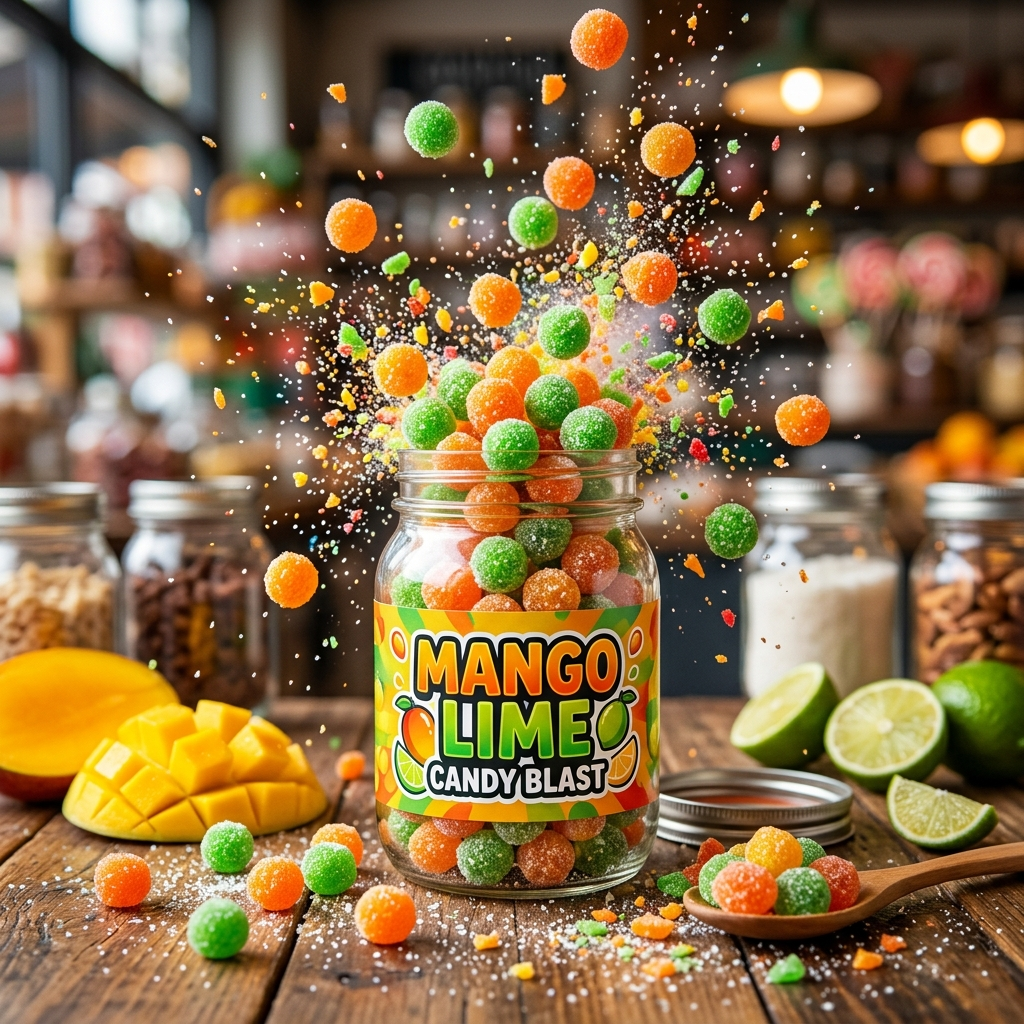
TheMango Lime Candy Blastis a tribute to this global love affair with “Swicy” (sweet and spicy) flavors. This isn’t your average store-bought gummy. It is a concentrated explosion of sun-drenched mango puree, sharpened by fresh lime juice, and finished with a shimmering coat of chili-lime salt.
Historically, preserving fruit as leather or “candy” was a necessity. Today, it’s an art form. This recipe bridges the gap between traditional fruit preservation and modern confectionery. Whether you grew up eatingchamoy-covered treats or are discovering the magic of lime-enhanced fruit for the first time, this recipe offers a sophisticated, chewy, and intensely flavorful experience that puts commercial “fruit snacks” to shame.
2. Recipe Overview
- Cuisine Type:Fusion / Tropical Confectionery
- Difficulty Level:Intermediate (Requires patience and temperature monitoring)
- Total Time:4 hours 30 minutes (30 mins prep, 4 hours setting/drying)
- Dietary Classifications:Vegan, Gluten-Free, Dairy-Free, All-Natural
3. Equipment and Tools
To achieve the perfect “snap” and chew of a professional-grade candy, you will need specific tools:
- High-Speed Blender:Essential for achieving a silk-smooth puree without fibers.
- Heavy-Bottomed Non-Stick Saucepan:3-quart capacity. The heavy base prevents the sugar from scorching.
- Digital Candy Thermometer:Precision is key for the “Soft Ball” stage.
- Silicone Candy Molds:Square or fruit-shaped (standard 1-inch cavities).
- Specification:Depth of at least 0.5 inches for a satisfying bite.
- Fine-Mesh Sieve:To remove any stubborn mango fibers.
- Silicone Spatula:Heat-resistant up to $450^\circ F$ ($230^\circ C$).
- Baking Sheet:To support the molds while setting.
4. Serving Suggestions
These candies are versatile showstoppers. Here is how to present them:
- The Cocktail Garnish:Skewer a Candy Blast on a cocktail pick and rest it across a Spicy Margarita or a chilled glass of Prosecco.
- The Charcuterie Balance:Place a bowl of these candies next to sharp cheddar or creamy goat cheese to cut through the richness.
- The Gift Presentation:Place candies in individual parchment liners inside a glass jar tied with a jute ribbon and a dried lime wheel.
- Beverage Pairing:Pairs beautifully with iced hibiscus tea (Jamaica) or a crisp, cold Ginger Beer.
5. Nutritional Information
(Estimated per 2-candy serving)
| Nutrient | Amount |
| Calories | 85 kcal |
| Total Fat | 0g |
| Sodium | 120mg |
| Total Carbohydrates | 22g |
| Sugars | 19g |
| Vitamin C | 15% DV |
Health Benefits:Unlike synthetic candies, this “Blast” uses real fruit pulp, providing a modest boost of Vitamin A and C. The capsaicin in the chili coating can also provide a very slight metabolic spark!
6. Storage and Reheating
Note:These are candies; do not “reheat” unless you intend to turn them back into syrup!
- Room Temperature:Store in an airtight container with parchment paper between layers for up to 1 week. Keep in a cool, dark place.
- Refrigeration:Best for humid climates. Will keep for 3 weeks.
- Freezing:You can freeze these for up to 3 months. They don’t freeze solid due to the sugar content, giving them a delightful “frozen fudge” texture.
- Pro Tip:If the candies become sticky, re-toss them in a mix of cornstarch and chili powder.
7. Expert Tips and Variations
- The “Pectin” Secret:Mangoes are naturally high in pectin, but for a firmer “gummy” texture, you can add a tablespoon of apple pectin during the boiling phase.
- Avoid the Grain:Do not stir the mixture once it reaches a boil, as this can cause the sugar to crystallize and become grainy.
- The “Manga Manila” Choice:Use Manila (Ataulfo) mangoes. They are less fibrous and sweeter than the Tommy Atkins variety.
- Variation – The “Green Blast”:Use slightly underripe mangoes for a more tart, acidic profile.
- Variation – The “Coco-Mango”:Replace 20% of the mango puree with thick coconut cream for a tropical “creamsicle” vibe.
8. Ingredients Section
The Fruit Base
- Fresh Mango Puree:2 cups (approx. 3-4 large mangoes) |500ml
- Freshly Squeezed Lime Juice:1/4 cup |60ml
- Lime Zest:1 tablespoon (finely grated)
The Candy Matrix
- Granulated Cane Sugar:1.5 cups |300g
- Light Corn Syrup (or Agave):1/2 cup |120ml(Prevents crystallization)
- Sea Salt:1/2 teaspoon
The “Blast” Coating
- Chili-Lime Seasoning (e.g., Tajín):3 tablespoons
- Citric Acid:1/2 teaspoon (for extra “zing”)
- Superfine Sugar:1 tablespoon
9. Step-by-Step Instructions
Step 1: Preparing the Puree
Peel and pit your mangoes. Blend the flesh until liquid. Pass the mixture through a fine-mesh sieve into a bowl to ensure zero fibers. Measure out exactly 2 cups.
Step 2: The Infusion
In your saucepan, combine the mango puree, lime juice, and lime zest. Bring to a simmer over medium heat for 5 minutes to reduce the water content slightly.
Step 3: The Syrup Phase
Add the cane sugar, corn syrup, and sea salt. Stir gently until the sugar dissolves. Attach your candy thermometer to the side of the pot, ensuring it doesn’t touch the bottom.
Step 4: The Hard Boil
Increase heat to medium-high. Let the mixture bubble. You are looking for the“Soft Ball Stage,”which is exactly:
$$235^\circ F – 240^\circ F \text{ (approx. } 113^\circ C – 115^\circ C)$$
This process usually takes 15–20 minutes. The mixture will thicken and turn a deep, translucent amber-orange.
Step 5: The Pour
Once the temperature is reached, remove from heat immediately. Pour the molten candy carefully into the silicone molds. Use an offset spatula to level the tops.
Step 6: The Cure
Let the candies sit at room temperature for at least 4 hours (overnight is better). Do not refrigerate yet, as the moisture can interfere with the setting process.
Step 7: The “Blast” Finish
In a small bowl, mix the chili-lime seasoning, citric acid, and superfine sugar. Pop the candies out of the molds and toss them in the mixture until fully coated.
10. Frequently Asked Questions (FAQ)
Q: Can I use frozen mango?
A: Yes! Thaw them completely and drain any excess water before pureeing. The flavor may be slightly less intense than fresh, sun-ripened fruit.
Q: My candy is too soft and won’t hold its shape. What happened?
A: You likely didn’t reach the full $235^\circ F$. If it’s too soft, you can use it as a “Mango Lime Jam” or stir it into yogurt!
Q: Is there a substitute for corn syrup?
A: You can use brown rice syrup or agave, though corn syrup is best for preventing a “grainy” texture in homemade candy.
Q: How do I make it more spicy?
A: Add 1/4 teaspoon of habanero powder to the boiling mixture for a deep heat, or increase the chili powder in the final coating.
Q: Can I use a different fruit?
A: Passion fruit or pineapple work well, but they have different pectin levels and may require a longer boiling time to set.